

Living heritage of Suriname
Winti
A living Afro-Surinamese religion, worldview and cultural heritage
01
Introduction
Winti is an Afro-Surinamese religion and worldview that took shape in Suriname from knowledge, cosmologies and religious practices carried under duress by enslaved Africans. People from different parts of West and Central Africa met on plantations and in urban communities. Under colonial oppression, shared elements were preserved, connected and further developed in a new Surinamese environment.
The word winti can refer both to the religion and to spiritual beings. In many accounts Anana, the Creator, stands above the winti. Ancestors, kinship, nature, responsibility and the search for balance are central themes. Winti is not a closed system with one holy book or central authority. Knowledge has mainly been transmitted orally, through experience and within families and communities. Names, interpretations and practices therefore vary between families, regions, specialists and lineages.
Winti is not a remnant of a finished past. It is living heritage in Suriname and its diaspora. For many people it connects spirituality with identity, family history, communal care and the restoration of dignity after slavery and colonialism. This page is a public introduction. It does not replace guidance from a qualified spiritual specialist and deliberately avoids disclosing restricted ritual knowledge.
02
History
Formation under slavery
From the seventeenth century, Dutch and other European traders forcibly transported African people to Suriname. They came, among other regions, from societies with Akan, Fon, Ewe and Kongo traditions. Different languages, concepts of divinity and ritual practices met on Surinamese soil. Winti did not begin with one event or founder, but through a long process of preservation, adaptation and creativity. It offered ways to understand relations with ancestors and nature, and to preserve community and personhood under inhumane conditions.
Colonial suppression
Missionaries and colonial officials often described African religions in hostile terms. Christian conversion was regularly accompanied by attacks on ancestral customs. The abolition of slavery in 1863 was followed by ten years of state supervision. In 1874 the colonial government criminalised so-called 'idolatry', and Winti was prosecuted under this provision. Public practice could result in detention or a fine. Knowledge and ceremonies did not disappear, but were increasingly transmitted beyond the view of government and church.
Repeal and recognition
The legal ban was repealed in 1971. The effects of nearly a century of criminalisation did not immediately vanish: shame, stereotyping and the false equation of Winti with evil or superstition persisted. Public organisation and recognition nevertheless increased. Suriname appointed its first Winti marriage officers in 2011. In 2014 Dorenia Babel received a public spiritual role as Okomfo fu Kondre. In the Netherlands, the annual libation at the National Slavery Remembrance Ceremony, led by Marian Markelo, is a visible moment of ancestral remembrance and restoration for many.
A history of resilience
The history of Winti is therefore both religious history and a history of resistance, continuity and cultural renewal. Its survival despite slavery, prohibition and demonisation demonstrates the strength of oral transmission and family and community networks. Contemporary practitioners determine for themselves how tradition, new knowledge and life in Suriname or the diaspora relate to one another.
Timeline
17e–19e
Formation under slavery
1874
Colonial criminalisation
1971
Legal ban repealed
2014
Public recognition of Okomfo fu Kondre
03
Worldview
Creator, winti and ancestors
In many Winti traditions Anana Keduaman Keduampon is regarded as the supreme Creator. The winti are spiritual beings or forces active within creation. Ancestors form an important link between past, present and future. They are not simply treated as 'gods': language concerning divinity, spirit and ancestry differs across sources and communities.
Four domains
A common arrangement distinguishes gronwinti (earth), watrawinti (water), busiwinti (forest) and tapuwinti (air or sky). Aisa is often associated with earth and motherhood. Other names and hierarchies vary by tradition. The four domains offer a first orientation, but should not be read as a complete or universally identical catalogue.
Personhood and kinship
Accounts of Winti discuss kra, yorka and dyodyo, among other spiritual aspects of a person. Precise interpretations vary. Family or bere is more than biological: the living, ancestors, responsibilities and transmitted knowledge form a moral and spiritual network. Wellbeing is often understood in relation to this network, the environment and one's conduct in life.
Balance and responsibility
Winti is not built around a simplistic opposition between 'good' and 'evil'. Harmony, right relationship, respect, purity, reciprocity and responsibility are recurring concepts. Disturbance may be understood personally, within a family, socially or spiritually. Restoration therefore requires careful discernment and appropriate guidance, rather than sensation or fear.
04
Traditions
Oral knowledge
Prayers, songs, stories, dreams, music, plant knowledge and ritual actions transmit knowledge. Much is learned through presence, listening and accepting responsibility. Not all knowledge is public. Some information belongs to a family, a specialist or a particular process of preparation.
Wintiprei, music and dance
A wintiprei is a ceremonial gathering in which song, rhythm, dance, food and community come together. Instruments such as the apinti and kwakwabangi may play a musical role. Trance or spiritual manifestation is meaningful in some traditions, but is not a public performance. Historical museum photographs were also made through a colonial lens; their captions require critical and respectful reading.
Wasi, herbs and cleansing
Wasi may refer to a ritual bath or washing with herbs and other natural materials. Purpose, composition and practice vary. Plant knowledge may be practical, symbolic and spiritual at the same time. Ritual care is not a substitute for necessary medical or psychological treatment; cooperation and safety should come first.
Libation and remembrance
During a libation, liquid is poured to honour ancestors, express gratitude or open a moment. The ceremony at the National Slavery Remembrance Ceremony in Amsterdam has made this gesture visible to a broad public. Its meaning lies not only in the action but in naming, memory, relationship and intention.
Specialists
Terms such as bonuman, obiaman, duman and lukuman occur in sources; their use and meaning may vary. A specialist works within a social and ethical framework and bears responsibility for those seeking guidance. The historical label 'medicine man' is often too crude and can misrepresent religious, diagnostic and healing roles.
05
Community
Winti is closely interwoven with Afro-Surinamese family history, but identity and practice are not the same for everyone. Some people explicitly identify Winti as their religion. Others recognise elements as culture, family custom or spirituality and combine them with Christianity or another worldview. This layering was shaped in part by centuries of forced conversion and secrecy.
In the diaspora, traditions acquired new public forms. Organisations, spiritual leaders, researchers, artists and families work to transmit knowledge and challenge stigma. Commemorations, books for young readers, podcasts and documentaries enable conversation between generations. Practitioners also warn against commercialisation, unqualified helpers and removing rituals from their context.
For young people Winti can open questions such as: Who were my ancestors? What knowledge did my family preserve? How did racism and religious suppression continue to affect us? The answer need not be religious practice for everyone. Careful learning, family conversations and respect for other people's boundaries are valuable in themselves.
06
Living heritage
Living heritage requires more than preservation. It requires space for practitioners to interpret their own tradition, for families to recover their histories and for institutions to reassess colonial descriptions critically. Museum objects and photographs may carry knowledge, but their original collection, classification and presentation must be transparent.
Research on Winti crosses history, anthropology, religious studies, spiritual care, art and health. Older publications are important, but may reflect the language and power relations of their time. Contemporary practitioner voices are therefore indispensable. Responsible heritage practice reads both alongside one another and acknowledges uncertainty and variation.
The future of Winti is not determined by a website. It lives in people, relationships, language, songs, care and memory. Digital access can nevertheless help by making reliable sources findable, respecting image rights and leaving room for corrections from the community.
Archive & collection
Images with context
Open each source for the full catalogue record and licence.

Winti ceremony in Suriname, circa 1910. Historical colonial photography; the people and context are sparsely documented.
Anonieme fotograaf / KITLV, Universitaire Bibliotheken Leiden · CC BY 4.0
View source and licence ↗
Winti dance in Suriname, circa 1910.
Anonieme fotograaf / KITLV, Universitaire Bibliotheken Leiden · CC BY 4.0
View source and licence ↗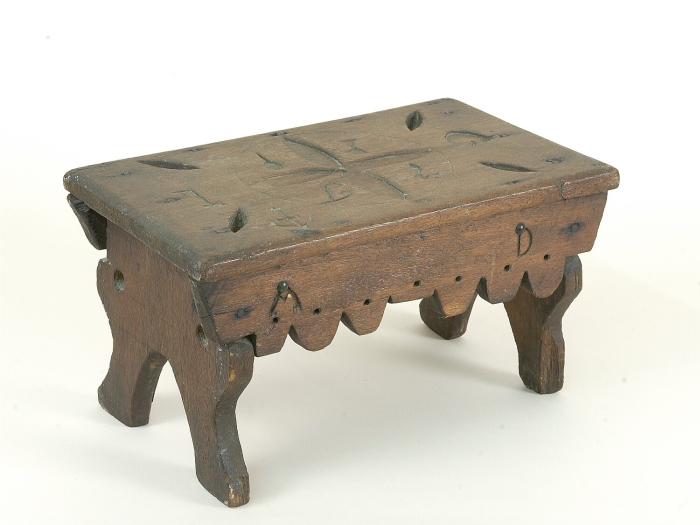
Kwakwabangi, a wooden bench that can also be played rhythmically, collected before 1955.
Collectie Wereldmuseum (v/h Tropenmuseum) · CC BY-SA 3.0
View source and licence ↗
Archive image, circa 1910. The original title reflects limited colonial cataloguing.
Anonieme fotograaf / KITLV, Universitaire Bibliotheken Leiden · CC BY 4.0
View source and licence ↗Sources & voices
Read, watch and listen
Winti: een Afroamerikaanse godsdienst in Suriname
Charles J. Wooding · 1972 / 2013
Cultureel-historische studie van religieuze verschijnselen in de Para; een invloedrijk academisch vertrekpunt dat in zijn tijd en context gelezen moet worden.
Open source ↗Winti: Afro-Surinaamse religie en magie bij Surinamers in Suriname en Nederland
Henri J.M. Stephen · 1983
Vroege Nederlandstalige publicatie over religie, ritueel en de praktijk in Suriname en Nederland; opgenomen in de Rijksmuseum Research Library.
Open source ↗Lexicon van de Winti-kultuur
Henri J.M. Stephen · 1986
Naslagwerk voor termen en begrippen uit de Winti-cultuur. Terminologie kan per traditielijn verschillen.
De macht van de Fodoe-winti
Henri J.M. Stephen · 1986
Verdiepende publicatie over Fodoe en rituelen in Suriname en Nederland.
Winti
Henna Goudzand Nahar en Marian Markelo; illustraties Rossel Chaslie en Renate Siepel · 2024
Toegankelijk jeugdboek over Winti, veerkracht, geschiedenis en de betekenis van cultureel erfgoed; ook geschikt als introductie voor volwassenen.
Open source ↗The Politics of Passion
Gloria Wekker · 2006
Antropologische studie van vrouwencultuur en seksualiteit in de Afro-Surinaamse diaspora, met relevante context over mati, spiritualiteit en sociale verhoudingen.
Open source ↗Spiritueel erfgoed
Iedereen Verlicht / NPO
Aflevering over Winti als traditionele Afro-Surinaamse religie en spiritueel erfgoed.
Open source ↗Winti | Het Alternatief
NPO 3 · 2021
Korte documentaire-aflevering over hedendaagse beleving en beeldvorming rond Winti.
Open source ↗Winti, een verhaal van veerkracht
Pakhuis de Zwijger · 2024
Lang programma met gesprek en verdieping rond het gelijknamige jeugdboek en Winti als verhaal van veerkracht.
Open source ↗Fayen weet alles van winti: 'Is het geloof van mijn voorouders'
NOS Jeugdjournaal · 2025
Een jonge beoefenaar vertelt in toegankelijke taal wat Winti voor haar betekent.
Open source ↗Annemiek Schrijver gaat op onderzoek uit: wat is winti?
De Verwondering / KRO-NCRV · 2025
Podcast en artikel met Linda Nooitmeer over oorsprong, voorouders, christendom en de hedendaagse betekenis van Winti.
Open source ↗Geestelijk specialisten in Suriname; een inleiding
Karin Boven en Welmoed de Boer · 1999
Wetenschappelijke inleiding over religieuze, spirituele en genezende deskundigheid in Suriname en de verwevenheid van die domeinen.
Open source ↗Hoe oude Winti-rituelen helpen bij de verwerking van het slavernijverleden
KRO-NCRV · 2023
Publieksartikel over geschiedenis, natuurdomeinen, wasi, dans, plengoffer en de rol van Marian Markelo bij de nationale herdenking.
Open source ↗Winti-objecten en historische fotografie
Wereldmuseum en Wikimedia Commons
Open collectiebeelden van onder meer de kwakwabangi en historische Winti-bijeenkomsten. Lees koloniale objecttitels en beschrijvingen kritisch.
Open source ↗