For nearly four centuries the Jewish community of Suriname has played a remarkable and complex role in the country's history — from Jodensavanne, the only autonomous Jewish agricultural settlement in the Americas, to today's synagogue standing side by side with a mosque in the heart of Paramaribo.
At a glance
- 1639 — First Sephardic Jews settle in Thorarica
- 1665 — Unique charter: full religious freedom and own jurisdiction
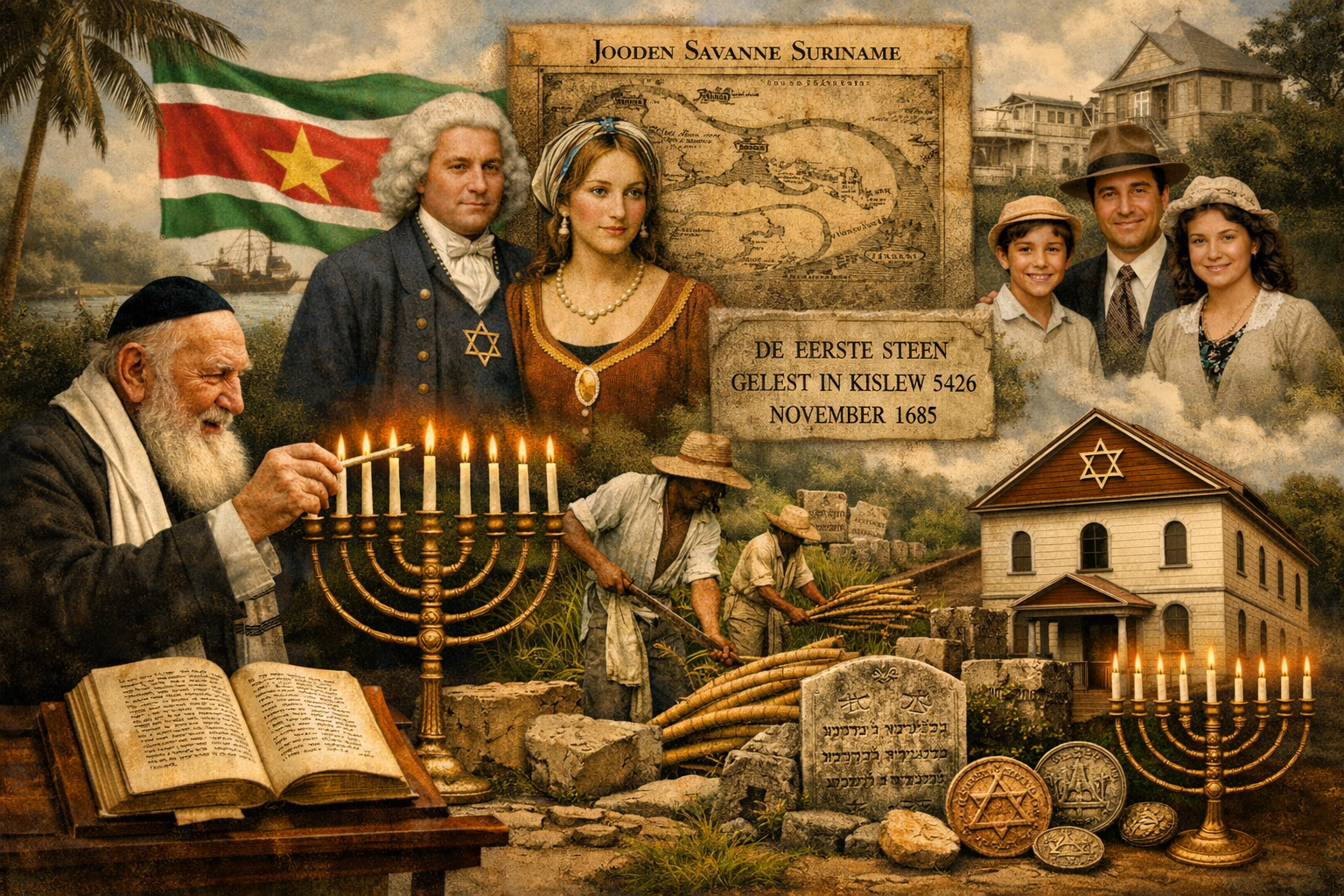
- 1685 — Beracha ve Shalom synagogue at Jodensavanne
- 1719 — Ashkenazi synagogue Neve Shalom in Paramaribo
- 1832 — Fire destroys Jodensavanne
- 1999 — Sephardim and Ashkenazim merge into one congregation
- 2023 — Jodensavanne added to the UNESCO World Heritage List
Contents
- 1. Arrival: refugees from the Inquisition
- 2. The 1665 charter — a world-historical exception
- 3. Jodensavanne — the "Jewish Savannah"
- 4. The hard truth: slavery and prosperity
- 5. Sephardim and Ashkenazim in Paramaribo
- 6. The decline of Jodensavanne
- 7. World War II: refugees and an internment camp
- 8. Independence and today's community
- 9. Jodensavanne as world heritage
- 10. A lasting legacy
- Sources and further reading
1. Arrival: refugees from the Inquisition
The Jewish presence in Suriname begins in the early seventeenth century. Sephardic Jews — descendants of those expelled from Spain (1492) and Portugal (1497) — sought safety in the New World.
As early as 1639 the English government allowed Sephardic Jews from the Netherlands, Portugal and Italy to settle on the Wild Coast, in the old capital Thorarica.
Three migration waves
A second group arrived in 1652 under the protection of Lord Francis Willoughby. A decisive third group came in 1664, led by David Cohen Nassy, after the French expelled them from Cayenne.
Many had earlier fled Dutch Pernambuco (Recife) when Portugal recaptured it in 1654, bringing both capital and advanced sugar-cultivation expertise.
2. The 1665 charter — a world-historical exception
On 17 August 1665 the English granted the Jewish community freedom of religion, the right to build synagogues and schools, their own court of justice, and their own civic guard. When the Dutch took the colony in 1667 (confirmed by the Treaty of Breda) they preserved these rights, formally reaffirming them in 1669.
Historian Aviva Ben-Ur has called this the only diaspora community with "complete political autonomy" before the founding of the State of Israel in 1948.
3. Jodensavanne — the "Jewish Savannah"
About fifty kilometres south of Paramaribo, on a higher savannah along the Suriname River near the Cassipora creek, the community built its own settlement: Jodensavanne.
Beracha ve Shalom (1685)
In 1685 the brick synagogue Beracha ve Shalom ("Blessing and Peace") was completed, financed in part by Samuel Nassy — one of the oldest synagogues in the Western Hemisphere.
Plantation boom
By 1694 the area counted nearly 9,570 souls (some 9,000 of them enslaved Africans) on more than forty plantations. By 1737 there were 115 Jewish-owned plantations producing sugar, coffee, cotton and cocoa.
4. The hard truth: slavery and prosperity
An honest history must confront the painful core: this prosperity rested on enslaved African labour. Around 1790 Jewish plantations held approximately 995 enslaved people.
No voice for abolition
Neither the Sephardic nor the Ashkenazi community ever publicly called for abolition, even at the moment of emancipation in 1863. Chief Rabbi M.J. Lewenstein (1857–1864) was long known as "the rabbi of the planters".
The Eurafrican Jews
At the same time a remarkable phenomenon emerged: the Eurafrican Jews or "Black Jews". Children of Jewish men and African women were often raised Jewish and given Jewish names. In 1759 they founded the brotherhood Darhe Jesarim ("Path of the Righteous") with their own prayer house at Sivaplein.
Until 1841 Jews of colour could not fully participate in the rituals of the "white" synagogues.
Some historians estimate that by the late eighteenth century the majority of Suriname's Jews had at least one African ancestor.
Originally Jewish surnames such as Pinto, Nassy, Fernandes and Robles de Medina survive today as Afro-Surinamese names; many Saamaka Maroon clan names refer to the Jewish plantations their ancestors escaped.
5. Sephardim and Ashkenazim in Paramaribo
From the early eighteenth century Ashkenazi Jews from Central and Eastern Europe also arrived. They built their own synagogue, Neve Shalom, in 1719. The wealthier Sephardim followed in 1735 with Tzedek ve Shalom. Tensions between the two communities only gradually faded.
6. The decline of Jodensavanne
The eighteenth century brought a cascade of crises:
- The Cassard expedition of 1712 imposed a heavy tribute.
- The 1773 collapse of the Dietz refinery in Amsterdam.
- The rise of European beet sugar from 1784.
- Depleted soils on the oldest plantations.
- Continual Maroon raids led by figures such as Boni.
Plantations were sold off cheaply to creditors and managed in absentia from the Netherlands. Around 1770 the great migration to Paramaribo began. In 1825 Suriname's Jews received equal civil rights — but lost their special autonomy. On 10 September 1832 Jodensavanne burned down and the jungle reclaimed the ruins.
7. World War II: refugees and an internment camp
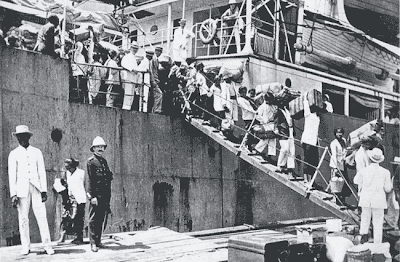
In 1942 a group of one thousand French Jews reached Suriname via Portugal. After the war the American Freeland League and a Surinamese government commission drew up the Saramacca Plan to settle 30,000 Jewish displaced persons; approved in 1947, it became moot when Israel was founded in 1948.
Camp Jodensavanne
A darker chapter unfolded at the same site: Camp Jodensavanne (Sept. 1942 – July 1946) interned 146 "irreconcilables" from the Dutch East Indies, mostly Indonesian-NSB members, under harsh conditions known in literature as "the green hell".
8. Independence and today's community
Most Jews left Suriname around independence in 1975 and during the Interior War of the 1980s. In 1999 the Sephardic and Ashkenazi congregations merged into the Jewish Community of Suriname. In 2004 it joined the World Union for Progressive Judaism. The 2012 census recorded 181 people as Jewish; today's community numbers about 130.
Synagogue and mosque as neighbours
Tzedek ve Shalom is rented out, its furniture on long-term loan to the Israel Museum in Jerusalem. Only Neve Shalom on Keizerstraat in Paramaribo remains active — directly next door to the Ahmadiyya mosque, sharing a courtyard.
The image of synagogue and mosque as neighbours has become a worldwide symbol of Surinamese religious tolerance — a living example of peaceful coexistence.
9. Jodensavanne as world heritage
The Stichting Jodensavanne, founded in 1971, cleared the site, conserved the synagogue ruins and uncovered some 450 graves. Declared a National Monument in 2009, the site was officially inscribed on the UNESCO World Heritage List on 19 September 2023 — recognised as the only place in the Americas where seventeenth-century Jews held an autonomous settlement with religious freedom, their own jurisdiction and their own militia.
10. A lasting legacy
Though the community has shrunk, the Jewish heritage of Suriname is everywhere — in surnames, in graves under the rainforest, in the architecture of Keizerstraat, and in the cuisine. At the seder before Passover at Neve Shalom, ever more non-Jewish Surinamese — Christians, Hindus, Muslims — are welcome guests.
Surinamese Judaism is not only history; it is a living part of Suriname's identity of diversity and coexistence.
Sources and further reading
- Aviva Ben-Ur, Jewish Autonomy in a Slave Society: Suriname in the Atlantic World, 1651–1825, University of Pennsylvania Press, 2020.
- Aviva Ben-Ur & Rachel Frankel, Remnant Stones. The Jewish Cemeteries of Suriname, Hebrew Union College Press, 2009.
- Wieke Vink, Creole Jews: Negotiating Community in Colonial Suriname, Brill, 2010.
- Robert Cohen, Jews in Another Environment. Surinam in the Second Half of the Eighteenth Century, Brill, 1991.
- Julie-Marthe Cohen (ed.), Joden in de Cariben, 2015.
- UNESCO World Heritage Centre, inscription no. 1680 (2023).