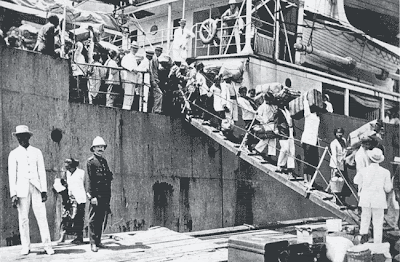
On 9 August 1890, the sailing ship SS Koningin Emma docked in Paramaribo with 94 contract workers aboard — the first Javanese on Surinamese soil. Their journey, not freely chosen, would become the foundation of one of Suriname’s most cohesive and culturally rich communities.
Background: a labour shortage
After abolition in 1863, freed Afro-Surinamese left the plantations as fast as they could. The Dutch authorities turned first to Chinese (1853) and British Indian (1873) labour, then — from 1890 — to Java, an over-populated island in the Dutch East Indies. Between 1890 and 1939, 32,965 Javanese contract workers were shipped to Suriname in 34 voyages.
Recruitment: between desperation and deceit
Recruiters promised “negeri sabrang” — “the land beyond the sea” — five years of well-paid work and a wealthy return. Many recruits believed they were going to a nearby island. Some were abducted or tricked through false promises of marriage. Once a fingerprint was on a Dutch contract, escape was impossible.
The crossing: three months at sea
The voyage took three to four months — through the Indian Ocean, around the Cape of Good Hope, across the Atlantic. Workers slept on rows of bunks in poorly ventilated holds. Cholera and dysentery struck regularly; on some voyages 5–10 percent died before reaching Paramaribo. Survivors were quartered in barracks at Mariënburg, Domburg, Lelydorp and other plantations under poenale sanctie: any breach of contract was punishable by jail or corporal penalties.
From plantation to village
Unlike the Hindustani, most Javanese stayed rural after their contracts. The Dutch handed out land in new settlements: Tamanredjo (“garden of happiness”), Lelydorp, Domburg, Mariënburg, Meerzorg. Wet rice paddies, coffee, cassava and vegetables grew there. The community kept its Javanese character: mosques, gamelan ensembles, wajang shadow plays, and Surinamese-Javanese language — still spoken today.
The return that mostly never came
Many wanted to return to Java but the cost was high and the Dutch preferred them to stay. Only about a quarter went back. The last ship was the SS Kota Gede in 1953 — for those left behind, a final farewell to family they would never see again.
1975 and after
At Surinamese independence in 1975 a large share of the community migrated to the Netherlands; today around 21,000 Javanese Surinamese live in the Netherlands, mostly in The Hague, Amsterdam and Almere. The Hague has become a second cultural capital. Since 2010, 9 August is the official Surinamese Day of Javanese Immigration.
Living heritage
Gamelan orchestras, wajang kulit shadow plays, and a kitchen of saoto soup, nasi goreng, bami, telo, gado-gado and sate remain central. Slamatan (community meal rituals) still mark births, weddings and deaths.
A community with two homelands
From the forced departures of 1890 to the fourth generation in Tamanredjo and The Hague, the Javanese-Surinamese community has turned a colonial labour contract into a rich double homeland. Today they make up almost 14% of Suriname’s population — an indispensable pillar of Surinamese identity. Their story, from deceit and barracks to gamelan and saoto, is one of resilience, memory and cultural wealth.
— Stichting Suriname Global Group