Walk through Paramaribo and the word “winkri” instantly evokes a Chinese corner shop. It is no coincidence. Since 1853 — ten years before slavery was officially abolished — Chinese migrants have been an indispensable thread in Suriname’s commercial fabric.
1853: the first contract workers
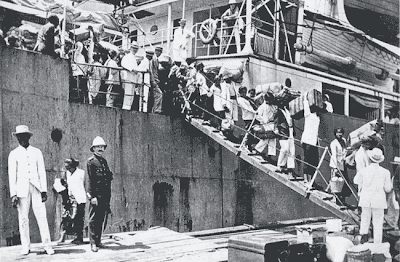
The Dutch colonial authorities saw abolition coming and recruited new labour for the plantations. In 1853 the first 18 Chinese contract workers arrived, mostly Hakka speakers from Guangdong and Fujian. Within a generation they had moved from plantation labour to commerce.
From plantation to shop
By 1900, Chinese families owned roughly three-quarters of all winkris (corner stores) in and around Paramaribo. The model was elegant: one relative ran a shop, brothers and cousins were brought over to open more, and one family importer in Paramaribo did business directly with Hong Kong. Credit and prices were coordinated within the family network — what economists would later call the “Chinese diaspora economy”.
Pioneers
The Hakka mutual aid societies Kong Ngie Tong Sang (1880) and Fa Tjauw Song Foei (1893) provided new arrivals with loans and language support. Out of this ecosystem grew families like Chin A Sen — and Henk Chin A Sen would become Suriname’s first president of the Republic in 1980.
The second wave
From the late 1990s a new wave of mostly Fuzhou-speaking migrants from Fujian transformed the streetscape again: supermarkets, restaurants and Chinese-led infrastructure projects. Estimates put this second wave at 30,000–50,000 between 1998 and 2015.
The Chinese kitchen as cultural bridge
No Surinamese warung is complete without tjap-tjoi, moksi-meti, bami or nasi. Originally Cantonese or Hakka dishes, they are now so woven into the national kitchen that most Surinamese consider them their own.
Today
Around 70,000 Chinese Surinamese live in Suriname, with a sizeable diaspora in the Netherlands. Since 2014, 20 October is the official Day of the Chinese Surinamese, commemorating the 1853 arrival. From frightened contract worker to confident entrepreneur, from isolated shopkeeper to import-exporter to president — Chinese Surinamese enterprise has been, and remains, one of the engines of the Surinamese economy.
— Stichting Suriname Global Group